

Factors Affecting Government Bond Interest Rates In India


In India, government securities yields are substantial indicators of investability in the debt market. This is because they serve as the risk free benchmark, which instantly reflects inflation expectations, RBI monetary policy, and fiscal health.
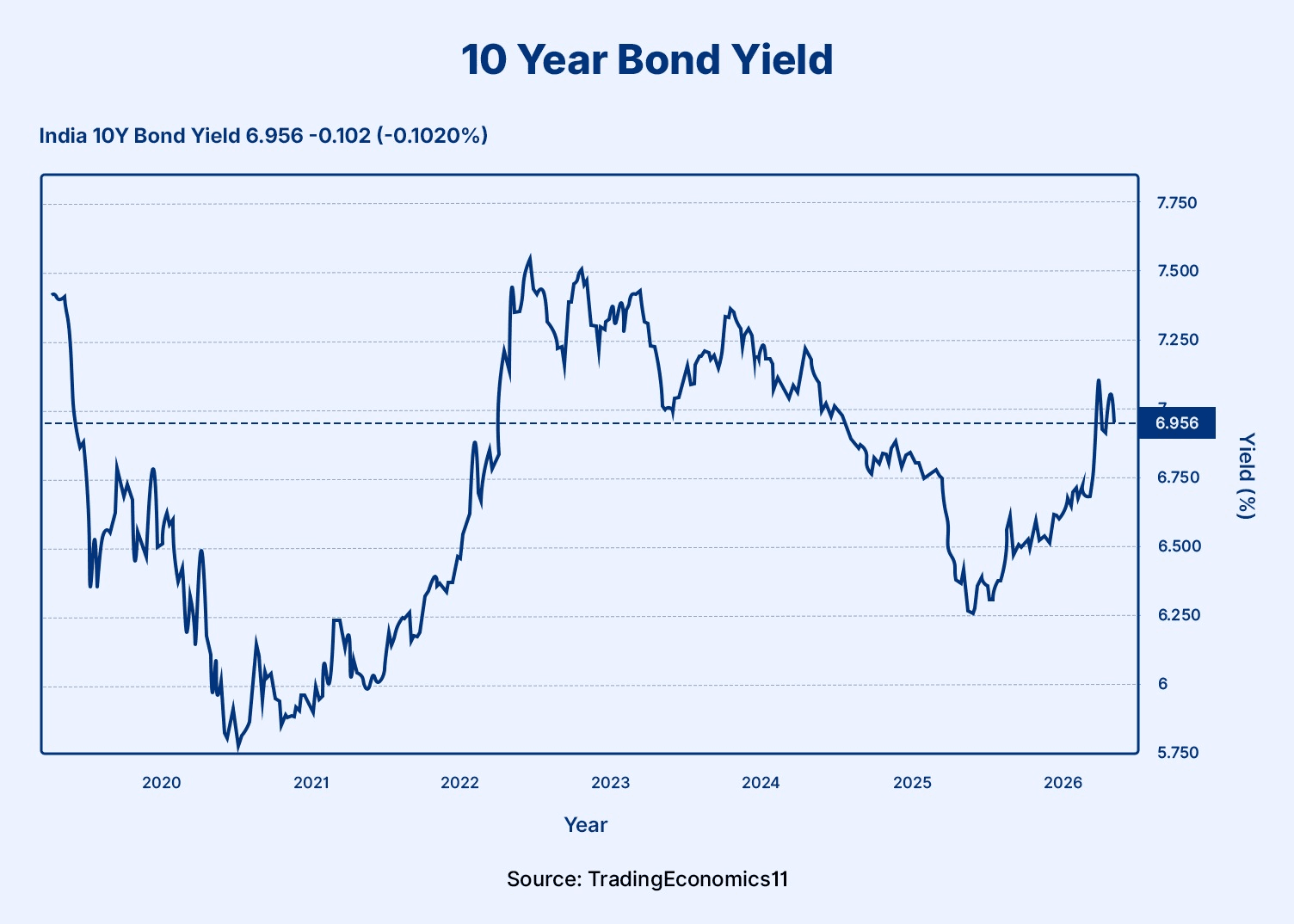
For instance, on 6 May 2026, Indian government bonds moved above 7%, driven by inflation concerns, crude oil volatility, and changing global interest rate expectations.1 Additionally, earlier this year, the benchmark 10-year bond yield in India climbed to 6.77%, the highest level in over one year, after the Union Budget projected higher-than-expected FY27 gross borrowing of INR 17.2 trillion.2
As a sovereign-backed instrument, their yields dictate interest rates for corporate debt, loans, and banking, acting as a real-time barometer of investor sentiment.
This blog analyses government bond yield in detail to aid investor decisions.
Types of Government Bonds In India
Several sub categories of government bonds in India exist, the most common among them being Dated Government Securities, Treasury Bills, State Development Loans, and Floating Rate Bonds. Understanding each of these categories is crucial for a nuanced take on government bonds, necessary for optimal investing.
1. Dated Government Securities (G-Secs): Medium to long term bonds issued by the central government, via the Reserve Bank of India (RBI), with fixed or floating interest rate and defined maturity are called G Secs. Even within this category, there exist several subdivisions, such as fixed rate bonds, floating rate bonds, sovereign gold bonds, etc. Therefore, the government securities yield, maturity, and other key characteristics vary based on the type.
2. Treasury Bills (T-Bills): Short-term, money market instruments issued commonly by the central government are called T-bills.3 Being money market, short-term securities, these assets often mature within a year. Their tenure can range from 91, 182, or 364 days. It is important to note that these assets are mostly zero-coupon securities, meaning they do not carry any interest. They are issued at a discount and redeemed at the face value or par value on maturity. Thus, the difference between the issue price and the redemption price acts as a gain for investors.
3. State Development Loans (SDLs): As the name suggests, SDLs are issued by state governments to raise funds for development projects. RBI conducts auctions to direct investments in these assets, which carry fixed interest. Compared to central government bonds, SDLs often carry a slightly higher yield due to their higher perceived risk.
4. Floating Rate Bonds: A type of dated G-Secs, Floating Rate Bonds do not have a fixed interest rate. The interest is linked to a benchmark rate, such as the repo rate or G-Sec yield, plus the spread. The coupon rate is reset periodically so that returns adjust with changes in interest rates. This protects investors from the risk of diminishing returns over time in a rising rate environment.
Let us now take a closer look at the Government Bonds India Interest Rate across different categories.
Current Interest Rates Across Bond Types
The interest rate across government bonds varies across instruments, with the yield shifting based on maturity, liquidity, inflation, and policy changes made by the RBI.4
Here are the sovereign bond interest rates in India as of early FY 2027:
Bond type | Current interest rate |
| Government securities (10-year G-sec) | 6.27% up to 7.49% |
| Treasury bills | 5.29% to 5.69% |
| State Development Loans (SDLs) | 7.43% to 7.80% |
| RBI Floating Rate Savings Bonds 2020 (Taxable) | 8.05% |
| Government of India Floating Rate Bond 2033 (FRB 2033) | 6.82% |
| Sovereign gold bonds | 2.5% fixed rate |
Source: RBI, CCIL India, economic times, business standard, 5,6,7,8,9,10
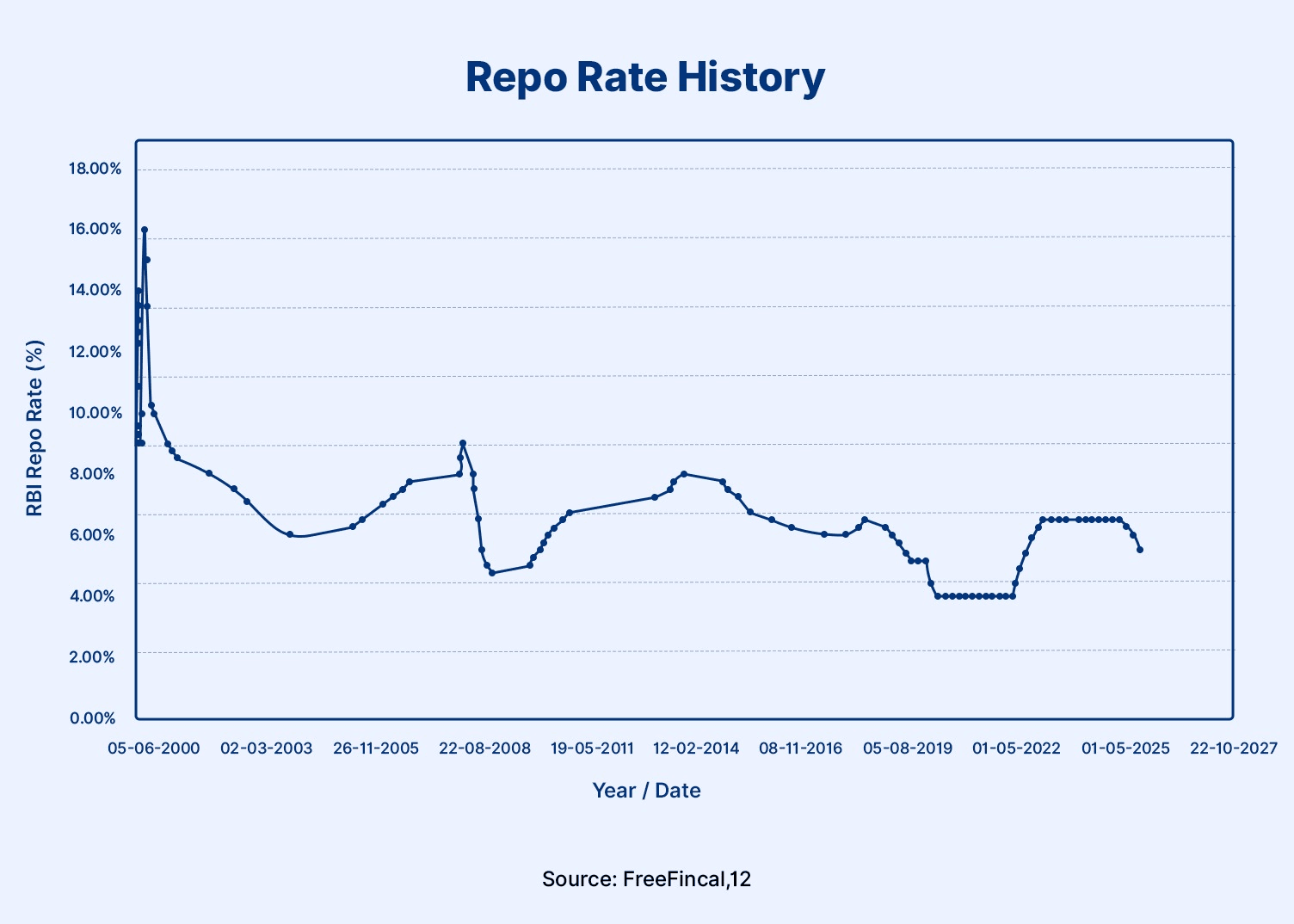
Over the last five years, the 10-year bond yield in India has moved closely with the RBI repo rate. While the repo rates rose significantly after 2022, G-Sec yields stayed elevated due to borrowing pressure, inflation concerns, and changing global interest rate expectations.
Inflation, Fiscal Deficit And Their Impact on Yields
Inflation and fiscal deficit both impact bond yields, but in a slightly different way. Inflation impacts the real return expectations and RBI policy, while fiscal deficit affects perceived sovereign risk and borrowing needs. Discussed below is a detailed breakdown of both these aspects.
1. Inflation and bond yield impact
The interest rate on bonds is fixed. Therefore, if inflation increases, the real return of bonds falls. For example, if the inflation increases from 2% to 3%, the real return from a 7% bond falls from 5% to 4%.
Furthermore, if inflation is above the target, the RBI typically increases the repo rate to control demand. A higher repo rate increases the interest rate of new G-Secs, resulting in a falling market price of existing bonds.
2. Fiscal deficit and bond yield impact
When the total expenditure of the government exceeds its total revenue, a fiscal deficit emerges. A higher fiscal deficit of the government implies the government needs to borrow through the issue of debt funds, like bonds, to bridge the gap. If the demand for such fixed-income assets remains constant, the government has to offer a higher yield to attract customers.
However, it is important to note that a persistent high deficit raises concerns about the fiscal health of the government. It raises the risk profile of the bonds, and thus their yield. Such trends can also trigger sell-offs, causing volatility in the secondary bond market.
Based on these trends, investors can analyse market data to invest in bonds with optimal yield.
Also read: Fiscal Deficit impact on bond yields
How To Lock In The Best Government Bond Rate?
Investors can follow the strategies listed below to analyse the bond investments available and choose one that suits them the most.
1. Choose the right window: An investor can analyse market and economic trends to understand the state of bond investments in India. For instance, if the market expects repo rate hikes, the yield might be higher. Investors can track the bonds in the secondary market and those issued newly to invest in competitive bond rates.
2. Right channel for investment: Not just banks and NBFCs, but several aggregator or brokerage platforms have emerged that curate bonds available currently for investment, along with all relevant information for investors. Rather than tracking individual bond issues, investors can use these platforms, like Grip, to sort bond investment opportunities based on required interest, risk profile, maturity, etc.
3. Bond choice based on tenure: If market trends suggest a fall in rates, longer-dated bonds not only lock in a higher coupon rate but also provide a greater capital gains opportunity if yields fall. Subsequently, for high inflation and yield volatility, short to medium term G secs and T bills reduce duration risk.
4. Fixed vs Floating Rate bonds: If the coupon rates are expected to fall or stay flat, choosing fixed-rate bonds locks in a high, known coupon rate. However, if rates rise, floating rate bonds reset upwards and yield better returns.
Therefore, when investing in bonds, a comparative analysis of different bond offerings helps make an optimal choice. Furthermore, an investor needs to be aware of interest and broader economic trends to make an optimal choice. Investors should also compare bonds with other fixed-income securities to ensure that they invest in an asset that suits them.
Also Read: Explore Latest Government Bonds Now
How RBI Monetary Policy Affects Government Bond Interest Rates
The Reserve Bank of India (RBI) plays a direct role in determining government bond interest rates through its monetary policy decisions, primarily the repo rate.
The Core Relationship: Repo Rate and Bond Yields
When the RBI changes its repo rate, government bond yields follow:
- RBI cuts repo rate - New bonds are issued at lower rates ? Existing bonds with higher coupons become more valuable - Bond prices rise, yields fall
- RBI hikes repo rate - New bonds offer higher returns ? Older bonds become less attractive ? Bond prices fall, yields rise
Simply put: bond yields and RBI rate decisions move in the same direction, while bond prices move in the opposite direction.
Where India Stands in 2026
The RBI has cut the repo rate by a cumulative 125 bps since 2025, bringing it to 5.25%. This easing cycle means government bond yields have softened — making it a good time for investors to lock in current rates before further cuts compress yields.
Other RBI Tools That Impact Bond Rates
Beyond the repo rate, two other tools influence bond yields:
- Open Market Operations (OMO): When RBI buys G-Secs, it injects liquidity, pushing yields lower. When it sells, yields rise.
- CRR And SLR: Higher reserve requirements reduce available funds in the banking system, putting upward pressure on yields.
Government Bonds vs FD Interest Rates
Fixed deposits are among the most common and conventional fixed-income securities. However, fixed-income assets also include government bonds, which offer a comparatively greater yield. The table below compares fixed deposits with government bonds.
| Parameters | Government Bonds | Fixed Deposits |
| Approximate interest rate | Up to 8% | Up to 7% |
| Liquid | Highly liquid due to the secondary market | Penalty levied on premature withdrawal |
| Capital appreciation | Higher | Lower |
| Maximum investment | No limit | No limit |
Source: India bonds,13
The rates given in the table above are standard expectations. Investors can access a greater yield or better risk profile, as risk-return varies from one issuer to another. For instance, Grip houses a range of PSUs, SDL bonds, T-Bills, etc. The table below lists some of them, as of 7 May 2026, to give readers an idea of the options available to them.
| Investment | YTM | Tenure | Minimum Investment |
| Government of India Bond | 7% | 6 months | INR 100 |
| Government of India Bond | 5.4% | 6 months | INR 103 |
| T-Bill | 5.4% | 10 months | INR 96 |
| T-Bill | 5.4% | 10 months | INR 96 |
| HUDCO Bond | 5.25% | 10 months | INR 1,038 |
Source: Grip invest, 14
Conclusion
The notion that fixed-income investments are only for conservative or risk-averse investors might be an oversimplification. Even high-growth-oriented investors can choose high-yielding fixed-income assets like government bonds for diversification and portfolio stability. Furthermore, choosing a government bond that aligns with return expectations and risk appetite requires optimal analysis through investment platforms and awareness about wider economic trends.
Grip houses a range of bonds, from corporate bonds to government securities, which can offer up to 12.5% YTM. Visit Grip today!
FAQs On Government Bond India
 |
Author: Grip Invest Editorial Team The Grip Invest Editorial Team is a group of Chartered Accountants, MBA (Finance) graduates, and Qualified Research Analysts dedicated to helping you invest smarter. We dive deep into India's fixed income landscape to deliver content that is accurate, up-to-date, and easy to understand. Whether you're exploring bonds, fixed deposits, or other fixed income opportunities, our guides cut through the noise and give you the clarity to make better financial decisions. |
Want to stay at the top of your finances?
Join the community of 4 lakh+ investors and learn more about Grip Invest, the latest financial knick-knacks, and shenanigans in the world of investing.
Happy Investing!
Disclaimer - Investments in debt securities/municipal debt securities/securitised debt instruments are subject to risks including delay and/ or default in payment. Read all the offer related documents carefully. The investor is requested to take into consideration all the risk factors before the commencement of trading.
This communication is prepared by Grip Broking Private Limited (bearing SEBI Registration No. INZ000312836 and NSE ID 90319) and/or its affiliate/ group company(ies) (together referred to as “Grip”) and the contents of this disclaimer are applicable to this document and any and all written or oral communication(s) made by Grip or its directors, employees, associates, representatives and agents. This communication does not constitute advice relating to investing or otherwise dealing in securities and is not an offer or solicitation for the purchase or sale of any securities. Grip does not guarantee or assure any return on investments and accepts no liability for consequences of any actions taken based on the information provided. For more details, please visit www.gripinvest.in
Registered Address - 106, II F, New Asiatic Building, H Block, Connaught Place, New Delhi 110001


