

Everything About State Development Loans: Interests And How To Invest


Most investors know about G-Secs. Fewer know about State Development Loans, government-backed securities that quietly offer 20–60 basis points more in yield.
These securities are issued by the state governments of India and are administered by the Reserve Bank of India. State development loans are a good option when interest rates are high, offering yields even better than those of the corresponding G-Secs. Thus, if you are looking for safe yields but do not want to venture into riskier instruments, SDLs can fit well into your portfolio.
Investors may explore SDLs as another avenue for generating stable income after diversifying from their traditional savings accounts or fixed deposits.
What Are State Development Loans And Who Issues Them?
SDL or State Development Loans are instruments of borrowing from the market that are floated by the states of India. They borrow money for developmental purposes such as constructing roads, expanding metro networks, developing health care systems, providing irrigation, and setting up educational institutions, among others. The need for such huge sums of money makes them turn to SDLs.
The Reserve Bank of India carries out such operations on behalf of state governments via auction procedures.
The buyers of these instruments effectively lend money to the states for a specific period and earn interest periodically as compensation. State development loans provide slightly higher returns than those offered by central government bonds.
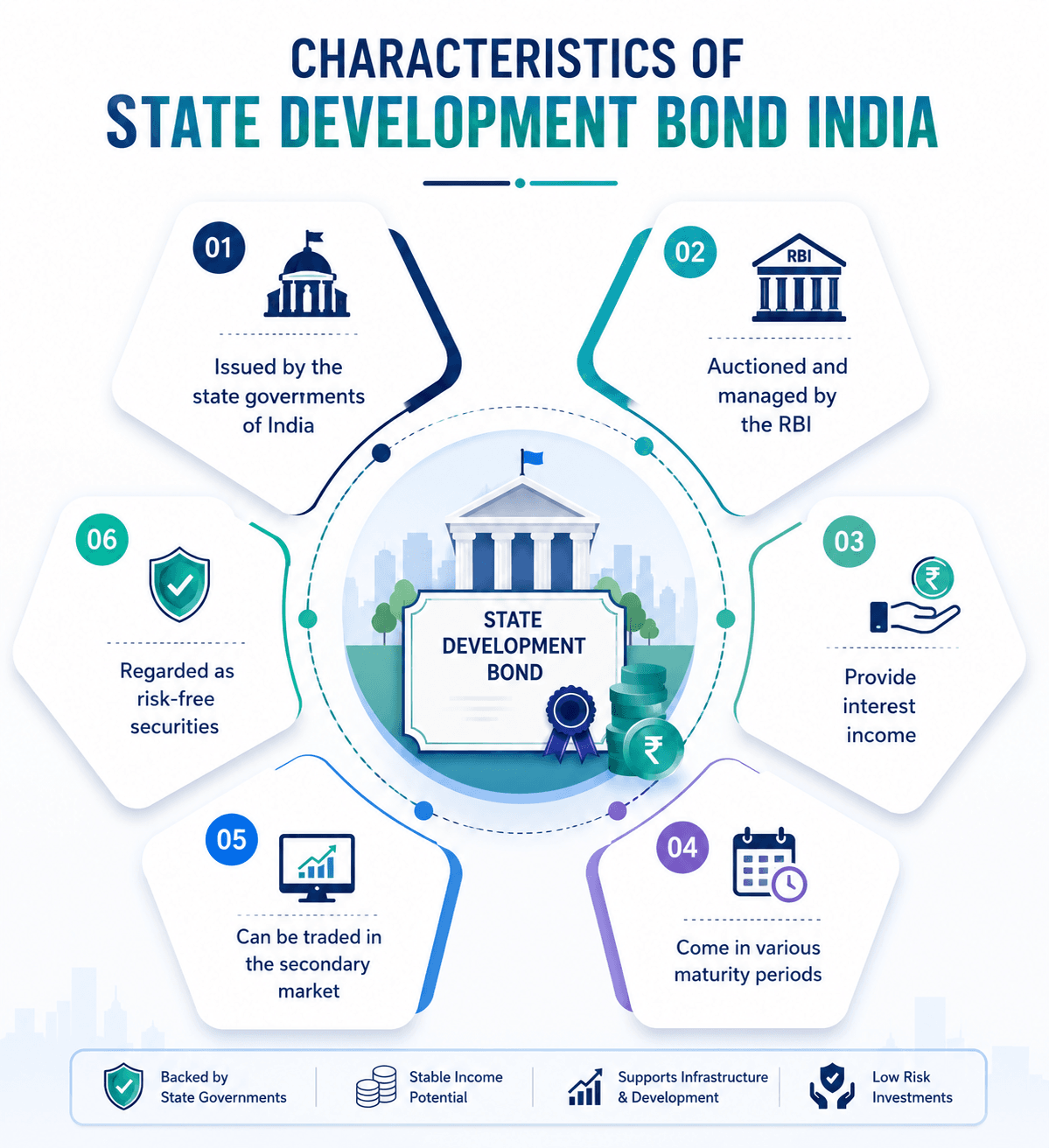
Characteristics Of State Development Loans India
- Issued by the state governments of India
- Auctioned and managed by the RBI
- Provide interest income
- Come in various maturity periods
- Can be traded in the secondary market
- Regarded as risk-free securities
How SDL Auctions Work (RBI's Role)?
The issuance of the state development loans is mainly done by the Reserve Bank of India. Instead of approaching investors themselves, state governments use the RBI to hold auctions to raise money from them. Auctions serve to ensure transparency and proper borrowing of funds.
During an auction, the states announce the total quantity and the duration of bonds they intend to raise. This information is used by investors, banks, insurance companies, and qualified individual investors to place their bids at a certain yield rate.
Working of the Auctioning Process
- State Governments announce their borrowing needs
- RBI publishes auction notices
- Investors submit competitive bids
- Allotment of bonds happens based on the yield that has been accepted
- Payment of interest happens regularly till maturity of the bond
The yield expected from investors will directly affect the state government's borrowing costs. The state governments may have to offer better yields to attract participation when demand is low. The RBI Retail Direct scheme facilitates retail investors' participation in SDL auctions.
SDL Interest Rate: Current Yield And Spread Over G-Secs
Another reason investors consider SDLs is that they offer higher yields than G-Secs. Even though both are government debt instruments, SDLs generally offer a better yield because of their lower liquidity in the financial markets.
Sometimes, even a marginal difference in yield can make a lot of difference in fixed income investments.
SDL Yield Definition
SDL yield refers to the profit made by keeping the bond until its maturity period. It is determined by such things as interest rate levels in the market, tenure of the bond, and investor preference.
Examples include the following:
Ten-year G-Sec yield: 7.0%
Ten-year SDL yield: 7.35%
In this case, SDL enjoys a spread of 35 basis points from the G-Sec.
Why Higher Yield on SDLs?
The yield on SDLs is usually higher due to the lower liquidity of these instruments when compared to government bonds. The level of indebtedness of states, as well as other factors, contributes to higher yields.
Traditionally, SDL spreads have been in the range of 20 to 60 basis points above their counterparts government bonds.
How To Buy SDLs?
Investing in SDLs is now easier for retail investors because there are various means of accessing the loans. Based on how you like investing, you may either purchase SDLs yourself or have them in professionally managed debt funds.
The following are some of the major methods of investing in SDLs.
RBI Retail Direct
The RBI Retail Direct portal enables investors to purchase bonds issued by the government directly through the RBI.
Process Of Investment
- Create an RBI Retail Direct account
- KYC process
- SDL auctions
- Online bidding
- Digital holding till maturity/sale
It would be a good option for investors who are confident about investing directly in bonds.
CSGL Accounts
Apart from banks, other financial organisations provide CSGL accounts that serve as an intermediary means to invest in government securities like SDLs.
Gilt Mutual Funds
Gilt funds are those that invest in government securities like G-Secs and SDLs. The advantage of this approach is that it gives you diversification and expert management of your money without having to participate in any auction process yourself.
For investors interested in gaining access to debt offerings easily, one way would be to use a platform like Grip Invest.
SDLs vs G-Secs vs PSU Bonds: Where Do They Fit
Fixed-income securities are not one-size-fits-all. Each instrument serves a different purpose depending on your risk appetite, return expectations, and investment horizon.
Understanding how SDLs compare with other debt instruments can help you build a more diversified fixed-income portfolio.
| Feature | SDLs | G-Secs | PSU Bonds | Corporate Bonds |
| Issuer | State Governments | Central Government | Public Sector Companies | Private/Listed Companies |
| Risk Level | Low | Very Low | Low–Moderate | Moderate |
| Yield Potential | Moderate–High | Moderate | Moderate–High | High |
| Liquidity | Moderate | High | Moderate | Low–Moderate |
| Interest Payments | Fixed | Fixed | Fixed | Fixed/Variable |
| Credit Risk | Negligible | None | Very Low | Depends on Rating |
| Suitable For | Income-focused investors seeking sovereign-like safety with better yields | Conservative investors prioritising capital preservation | Investors seeking PSU-backed stability with slightly higher returns | Return-focused investors comfortable with moderate credit risk |
SDLs occupy a sweet spot in the fixed-income universe they carry negligible credit risk like G-Secs, while offering a yield premium of 20–60 basis points above them. PSU bonds offer a similar safety profile but are tied to individual public sector companies.
Corporate bonds, while offering the highest yield potential, require careful evaluation of the issuer's credit rating, financial health, and repayment track record.
For investors building a balanced debt portfolio, combining SDLs with corporate bonds can offer both stability and enhanced return potential with SDL providing the low-risk anchor and corporate bonds driving yield.
Should You Invest?
State Development Loans (SDLs) are an option for those searching for dependable fixed-income assets that offer superior returns compared to conventional treasury securities.
Nevertheless, as is the case with all debt obligations, state development loans will be susceptible to fluctuations in interest rates and liquidity. Your financial objectives, risk tolerance, and intended investment duration should determine your investment strategy.
Investing in SDLs may prove challenging for individuals who lack experience in participating in bond auctions or trading debt securities in the secondary market. Investors seeking an easier route into debt securities may consider using online platforms such as Grip Invest.
Conclusion
With advances in fixed-income investing, state development loans have become a highly relevant investment avenue for individuals seeking decent returns while avoiding the risks of default on a larger scale.
SDLs can be used effectively by investors exploring various avenues of debt investments, as these bonds can give better returns than G-Secs. It is necessary that you know about the yield, liquidity, and ways of investment before investing in state development loans.
In case you are looking for some fixed income investments but do not want to deal with auctions and other complications, then explore your investing options at Grip Invest
FAQs On State Development Loans
 |
Author: Grip Invest Editorial Team The Grip Invest Editorial Team is a group of Chartered Accountants, MBA (Finance) graduates, and Qualified Research Analysts dedicated to helping you invest smarter. We dive deep into India's fixed income landscape to deliver content that is accurate, up-to-date, and easy to understand. Whether you're exploring bonds, fixed deposits, or other fixed income opportunities, our guides cut through the noise and give you the clarity to make better financial decisions. |
Want to stay at the top of your finances?
Join the community of 4 lakh+ investors and learn more about Grip Invest, the latest financial knick-knacks, and shenanigans in the world of investing.
Happy Investing!
Disclaimer - Investments in debt securities/municipal debt securities/securitised debt instruments are subject to risks including delay and/ or default in payment. Read all the offer related documents carefully. The investor is requested to take into consideration all the risk factors before the commencement of trading.
This communication is prepared by Grip Broking Private Limited (bearing SEBI Registration No. INZ000312836 and NSE ID 90319) and/or its affiliate/ group company(ies) (together referred to as “Grip”) and the contents of this disclaimer are applicable to this document and any and all written or oral communication(s) made by Grip or its directors, employees, associates, representatives and agents. This communication does not constitute advice relating to investing or otherwise dealing in securities and is not an offer or solicitation for the purchase or sale of any securities. Grip does not guarantee or assure any return on investments and accepts no liability for consequences of any actions taken based on the information provided. For more details, please visit www.gripinvest.in
Registered Address - 106, II F, New Asiatic Building, H Block, Connaught Place, New Delhi 110001


