

20 Lakh FD Interest Per Month: How Much Monthly Income Can You Earn?


Planning a steady passive income stream without taking high market risks? A Fixed Deposit (FD) remains one of the most trusted investment options in India.1 But one of the common questions that many investors ask is that how much monthly income can you earn from a INR 20 lakh FD?
Whether you are a retiree looking for stable cash flow, a salaried professional planning additional income, or someone searching for low risk investment options, understanding the 20 lakh FD interest per month can help you make smarter financial decisions.
In this guide, we will break down monthly income calculations, tax implications, payout options, and better alternatives to maximize your returns.
Why Investors Prefer FDs For Passive Income?
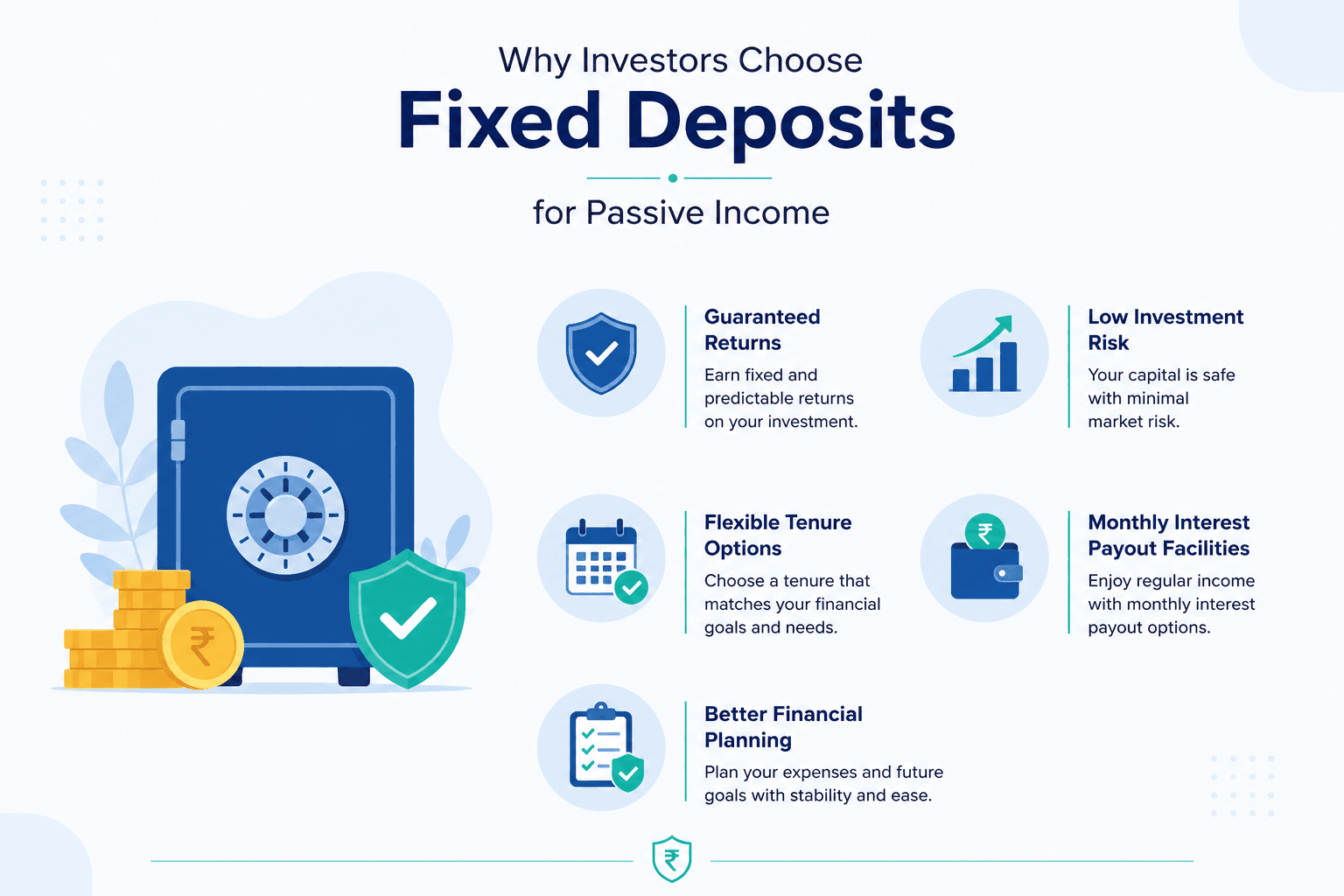
Fixed Deposits are popular because they offer:
- Guaranteed returns
- Low investment risk
- Flexible tenure options
- Monthly interest payout facilities
- Better financial planning
Many investors use monthly income FD plans to manage household expenses, retirement income, or emergency cash flow.2
But can INR 20 lakh generate meaningful monthly income?
The answer depends on:
- Interest rate
- FD type
- Payout frequency
- Taxation
- Investor category (senior citizen or regular investor)
Now the question is Can You Earn Monthly Interest From an FD?
Yes, you can. To earn monthly payouts, investors need to choose a non cumulative FD
What is a Non-Cumulative FD?
In a non-cumulative FD:
- Interest is paid regularly
- Investors can receive payouts monthly, quarterly, or annually
- Ideal for those seeking passive income from FD investments
In contrast, cumulative FDs reinvest the interest and pay the entire maturity amount at the end of the tenure.3
How Can We Calculate Monthly Income On INR 20 Lakh FD?
The basic formula for monthly FD income is:
Monthly Interest = Principal × Interest Rate / 12*100?
Let us calculate the estimated monthly income from a INR 20 lakh FD at different interest rates.4
Interest Rate | Annual Interest | Monthly Income |
| 6% | INR 1,20,000 | INR 10,000 |
| 7% | INR 1,40,000 | INR 11,667 |
| 8% | INR 1,60,000 | INR 13,333
|
Source: Bajaj Finserv,5
Scenario 1: 6% FD Interest Rate
At 6% annual interest:
- Total yearly earnings = INR 1.2 lakh
- Monthly income = around INR 10,000
This rate is commonly offered by traditional banks for standard tenure FDs.
Scenario 2: 7% FD Interest Rate
At 7%:
- Annual earnings = INR 1.4 lakh
- Monthly payout = approximately INR 11,667
Several banks and NBFCs offer these rates depending on tenure and market conditions.
Scenario 3: 8% FD Interest Rate
At 8%:
- Annual returns = INR 1.6 lakh
- Monthly income = approximately INR 13,333
Certain corporate FDs and high-yield fixed-income products may offer rates close to this range. Investors also explore platforms like Grip Invest for corporate FD opportunities that can potentially provide higher returns than traditional bank FDs.
Tax Impact On Actual FD Income
While Fixed Deposit returns are stable and predictable, taxation can reduce your actual monthly earnings. Before investing, it is important to understand how tax affects your ?20 lakh FD interest per month.
1. TDS on FD Interest
Banks deduct TDS (Tax Deducted at Source) if your annual FD interest crosses the prescribed limit.6
| Investor Type | TDS Limit |
| Regular Investors | INR 40,000 |
| Senior Citizens | INR 50,000
|
2. Income Tax Slab Impact
FD interest is fully taxable under “Income from Other Sources.” The tax payable depends on your income tax slab.7
For example:
- A person in the 30% tax slab earning INR 1.6 lakh annual FD interest may pay nearly INR 48,000 as tax.
Example of Post Tax Monthly Income
| Interest Rate | Monthly Income | Estimated Post-Tax Income (30% slab) |
| 6% | INR 10,000 | INR 7,000 |
| 7% | INR 11,667 | INR 8,167 |
| 8% | INR 13,333 | INR 9,333
|
Also read : Premature Withdrawal Rules
Senior Citizen Tax Benefits
Senior citizens may receive:
- Higher TDS exemption limits
- Tax deductions under Section 80TTB
This can help improve overall post-tax monthly income.
What Are The Factors That Affect FD Returns?
Several important factors influence the actual returns and monthly income you can earn from a ?20 lakh Fixed Deposit. While the interest rate is the biggest deciding factor, aspects like tenure, institution type, investor category, and payout frequency also play a major role in determining your final earnings-
1. FD Tenure
The tenure of your Fixed Deposit directly impacts the interest rate and overall returns. Banks and financial institutions usually offer different FD rates for different investment periods.
Generally:
- Longer tenure FDs may offer higher interest rates
- Longer investment duration can improve overall returns
- Stable tenure helps lock in rates during favorable market conditions
However, rates vary depending on market conditions.
2. Bank vs NBFC Interest Rates
The type of institution you choose significantly affects your FD returns.
Bank FDs
Traditional banks are considered safer and more stable. They offer:
- Reliable returns
- High investor trust
- Better liquidity
However, large banks may provide slightly lower interest rates.
NBFC FDs
NBFCs (Non-Banking Financial Companies) generally offer:
- Higher FD interest rates
- Better monthly payout potential
- Attractive returns for long-term investors
However, before investing in NBFC FDs, investors should carefully evaluate:
- Credit ratings
- Financial stability
- Company reputation
- Safety of investment
Higher returns should always be balanced with investment security.
Senior citizens usually receive additional benefits on Fixed Deposits, making them a preferred retirement investment option.
Most banks and NBFCs offer:
- Extra 0.25%–0.75% interest
- Better monthly income
- Higher overall returns7
For example:
- A 7% FD may become 7.5% for senior citizens.
4. Payout Frequency
The payout frequency determines how often you receive FD interest income.
Monthly Payouts
Monthly income FDs are ideal for investors who need:
- Regular cash flow
- Retirement income
- Monthly expense support
Benefits include:
- Predictable income
- Better budgeting
- Consistent passive earnings
Better Alternatives For Monthly Income
While FDs are safe, some investors also explore alternatives for potentially higher returns.
1. Senior Citizens Savings Scheme (SCSS)
Best suited for retirees:
- Government-backed
- Attractive interest rates
- Quarterly payouts
Also Read: Senior Citizen FD Rates 2026
2. Debt Mutual Funds
Can offer:
- Better tax efficiency
- Liquidity
- Potentially higher returns
However, market risks exist.
3. Bonds
Corporate and government bonds may provide:
- Fixed coupon payments
- Predictable income streams
Risk levels vary depending on issuer quality.
4. SWP (Systematic Withdrawal Plan)
Investors use SWPs in mutual funds to:
- Generate regular monthly cash flow
- Potentially beat inflation over time
Suitable for long-term wealth planning.
How To Choose The Right Monthly Income FD?
1. Monthly Income Needs
Calculate the exact monthly amount you need from your FD before choosing a tenure or interest payout frequency. For instance, a senior citizen needing INR 10,000 per month as supplementary income will choose a different FD structure than someone parking a lump sum for passive yield. Make sure the interest payout from the FD is sufficient to cover your recurring expenses without dipping into the principal.
2. Tax Bracket
FD interest is taxed as per your income tax slab under the head "Income from Other Sources." If you fall in the 30% tax bracket, a significant portion of your FD returns will go toward taxes, reducing your effective yield. In such cases, comparing the post-tax returns of FDs with tax-efficient alternatives like debt mutual funds or tax-free bonds becomes essential.
Also, TDS at 10% is deducted if your FD interest exceeds INR 40,000 per year (INR 50,000 for senior citizens).
3. Investment Horizon
FD tenures typically range from 7 days to 10 years. Longer-tenure FDs often offer higher interest rates, but locking in funds for too long can be a disadvantage if interest rates rise. If you are unsure about your horizon, consider laddering your FDs splitting INR 20 lakh across multiple FDs with different tenures so that a portion matures periodically, giving you both liquidity and rate optimisation.
4. Liquidity Requirements
Most FDs allow premature withdrawal, but this usually comes with a penalty of 0.5% to 1% on the applicable interest rate.
If you anticipate needing funds before maturity for medical emergencies, large purchases, or opportunities either opt for a flexible or sweep-in FD, or keep a portion in a liquid instrument and invest only what you can afford to lock in.
5. Risk Tolerance
FDs are among the safest investment instruments, with deposits up to INR 5 lakh per bank per depositor insured under the DICGC scheme. However, if you are investing INR 20 lakh in a single bank, only INR 5 lakh is insured. Consider spreading your FD investment across multiple banks to maximise deposit insurance coverage and reduce concentration risk.
6. Issuer Selection
Not all FDs carry the same risk. Small finance bank FDs and corporate FDs may offer higher interest rates sometimes 1% to 2% above large bank rates but they carry relatively higher credit risk.
Always check the credit rating of corporate FDs (AAA-rated issuers are the safest) and the track record of the bank before committing large sums.
Diversifying between FDs, bonds, and debt instruments may help optimize returns and reduce concentration risk.
Conclusion
A INR 20 lakh Fixed Deposit can be a reliable source of passive income, especially for investors seeking stability and predictable monthly returns. Depending on the interest rate, you can earn between INR 10,000 and INR 13,333 per month through a non-cumulative FD payout option. However, factors like taxation, tenure, payout frequency, and the type of institution significantly impact your actual earnings. While FDs remain one of the safest investment choices, exploring alternatives like SCSS, bonds, debt funds, or SWPs can help improve overall returns and income efficiency. Before investing, compare interest rates carefully and align your investment choice with your financial goals and income needs.
Grip offers corporate bonds and other fixed-income investment options with yields up to 12.5% and institutional-grade security features. Visit Grip Today!
FAQs On Monthly Income From FD
 |
Author: Grip Invest Editorial Team The Grip Invest Editorial Team is a group of Chartered Accountants, MBA (Finance) graduates, and Qualified Research Analysts dedicated to helping you invest smarter. We dive deep into India's fixed income landscape to deliver content that is accurate, up-to-date, and easy to understand. Whether you're exploring bonds, fixed deposits, or other fixed income opportunities, our guides cut through the noise and give you the clarity to make better financial decisions. |
Want to stay at the top of your finances?
Join the community of 4 lakh+ investors and learn more about Grip Invest, the latest financial knick-knacks, and shenanigans in the world of investing.
Happy Investing!
Disclaimer - Investments in debt securities/municipal debt securities/securitised debt instruments are subject to risks including delay and/ or default in payment. Read all the offer related documents carefully. The investor is requested to take into consideration all the risk factors before the commencement of trading.
This communication is prepared by Grip Broking Private Limited (bearing SEBI Registration No. INZ000312836 and NSE ID 90319) and/or its affiliate/ group company(ies) (together referred to as “Grip”) and the contents of this disclaimer are applicable to this document and any and all written or oral communication(s) made by Grip or its directors, employees, associates, representatives and agents. This communication does not constitute advice relating to investing or otherwise dealing in securities and is not an offer or solicitation for the purchase or sale of any securities. Grip does not guarantee or assure any return on investments and accepts no liability for consequences of any actions taken based on the information provided. For more details, please visit www.gripinvest.in
Registered Address - 106, II F, New Asiatic Building, H Block, Connaught Place, New Delhi 110001


