

What Is A Fixed Deposit? Everything You Need To Know Before Investing


Our elders usually tell us about saving our money and investing in fixed deposits (FDs). In modern times, when there is a heavy influx of information regarding various financial instruments, there is usually a question - What is a fixed deposit? How does it save money?
What Is A Fixed Deposit?
Fixed deposits are one the most famous investment instruments that help lock money with banks and financial institutions and provide some return over it. After the nationalisation of the Reserve Bank of India (RBI) in 19491, people started realising the significance of the banking industry. It further made them realise the value of investment. Thus, FDs are a popular investment instrument among the elder generations.
In the start, FDs were only offered by banks. However, now financial institutions also offer the facility. Their rates differ from each other. FDs help investors make a one-time investment, unlike recurring deposits (RD), which are also time deposits but need frequent investments.
How Does An FD Work?
The functioning of FD is very feasible to understand. Fixed deposit account is a type of term deposit, meaning it is locked for a specific period of time. Moreover, banks and financial institutions offer interest rates, which grow money annually (or as per the term specified in the scheme document).
Depositors can withdraw their funds before the tenure in some cases, but it may reduce their interest amount due to a penalty.
Let us understand with an example:
Ms. Abc kept INR 20,000/- in the XYZ bank. The bank offered FD for five years with an interest rate of 6.5%. Fixed deposit interest rates are compounded yearly.
Final Amount = Initial Amount (1+Interest Rate%) ^ Time period
Final Amount = [20,000(1+6.5%)^5]
Final Amount = INR 27,400/-
Therefore, she will earn an interest amount of nearly INR 7,400/-.
Banks and financial institutions earn interest from their loans and pay interest on deposits. The difference between them is the profit margin for banks.
What About Fixed Deposits Is So Unique?
- Tenure
As the name suggests, the period for deposit is fixed in this investment. This period differs by the type of FDs. Short-term FDs have tenure for some days to 12 months2. Long-term FDs usually have a tenure of more than one year. Investors should decide on a feasible option by ascertaining their long-term and short-term requirements.
- Safety
One of the most attractive features of FDs is the security of funds. Reserve Bank of India (RBI) is the head bank and is in charge of the banking industry in India. Further, the deposit insurance and credit guarantee corporation (DICGC) insures all deposits such as savings, fixed, current, recurring, etc.
As a depositor, you are insured upto a maximum of INR 5 lakh3 for both principal and interest amount held.
- Saving Behaviour
The predetermined term helps save money for short or long-term investments. Moreover, some institutions also provide the facility of auto-renewal of the FDs, which further helps re-invest the investment.
- Premature Withdrawal
Most institutions offer withdrawal before maturity. In such a case, some penalty is charged by reducing the interest by some days, and post-withdrawal, the fixed deposit account is closed.
For example, A 5-year FD of INR 10,000/-, offering interest at 5% simple interest per annum, is withdrawn by the depositor six months before the maturity. The depositor would get full interest for 4 years i.e. INR 2,000/-. Further, interest would be calculated for six months i.e. INR 250/-. Finally, the depositor would get the amount of INR 12,250/-.
- Mode Of Investment
FDs are investments offered by both - banks and non-banking financial companies. Usually, NBFCs offer higher interest than banks as they contain higher risk and are not secured under DICGC leading to higher risk. Due to growing digital exposure, the institutions also offer online FD facilities.
- Taxation
Depositors get deductions for the interest on specific tax-saver FDs under Section 80C4 of the Income Tax Act, 1961. Interest on FDs is taxable under “Income from other sources”. Moreover, tax is deducted on source (TDS) on such interest at 10%5 under Section 194A.
- Auto-renewal
Mostly, all institutions offer the facility of auto-renewal for fixed deposits. In this, money would be re-invested in the FD after its maturity. If the depositor has any pre-decided use of money, then one can receive the matured amount, else re-invest.
Also Read: Post Office FD Interest Rates 2025
Types Of Fixed Deposits
1. Regular FDs
These are the most famous FDs which have a predetermined term. Due to this, they have higher interest rates than regular savings accounts.
2. Taxable FDs
These are specifically designed to offer tax benefits. They usually have a lock-in period of five years6 and depositors can obtain tax deductions on the interest income of such FDs under Section 80C, up to INR 1.5 lakhs (total deduction).
3. Senior citizen FDs
Senior citizens usually seek a stable income source in their old age, due to lack of fixed incomes like salary. Thus, FDs provide a feasible option and higher interest rates than regular FDs. It is to support the needs of senior citizens.
4. NBFC FDs
Companies have varied options for investment, and to balance, fixed deposit accounts offer safety and balance the risk in the portfolio. Institutions offer corporate fixed deposits, which have potential interest rates.
5. Flexi FDs
It is a combination of demand deposits and fixed deposits. Depositors will get liquidity of savings and current accounts, along with the fixed deposits interest features. Also, some banks offer the facility of ‘auto-sweep’ in which the surplus of savings account is transferred to fixed deposit, after the customer’s intimation.
What Are Bank Fixed Deposit Eligibility Criteria?
Investment in FDs are reasonable and a good start for investors seeking safe returns. A depositor should be of age 18 or more. If not, then children above 10 years can open a fixed deposit account with their natural or legal guardian. The minimum investment limit changes as per bank norms. So, any individual can make this investment after properly understanding different options and personal needs.
Does A Longer Tenure Always Mean Higher Returns?
Contrary to popular belief, a longer tenure might not automatically result in higher returns. There are circumstances such as the existing economic conditions, promotional offers, and liquidity requirements (of banks) based on which even short-term FDs can provide higher returns.
Example: Akshat is planning to buy a new iPhone after two years. He has INR 1 lakh set aside and is comparing two FD options. Here is what he will have at the end of the two-year period:
| Option One | Option Two |
Principal | INR 1,00,000 | INR 1,00,000 |
Tenure | 1 year, then reinvested for 1 more year | 2-year cumulative FD |
ROI | 9.50% p.a. | 8.25% p.a. |
Maturity Amount | INR 1,19,902.50 | INR 1,17,180.63 |
Excess Interest (in %) over Option Two | 2.32% | - |
What Tenure Of Fixed Deposit Should You Opt For?
Having a longer tenure can typically lead to higher returns in the long-term but it is not a rule of thumb. There are numerous exceptions to this, as suggested by the previous example. Consequently, you should consider your personal financial position and goals before zeroing on a tenure.
You must also carefully analyse the impact of interest rates offered by different banks and its effect on your financial goals. Currently, ROI on FDs can go up to as high as 7.5-9.40% (depending on FD category and banks).
If you are looking towards retirement planning or any other long-term financial goal, you must try to avail an FD with as high ROI as possible to lock-in the high FD rates.
Example (Cont.): Getting back to Akshat, who is now contemplating retirement planning. He plans on retiring after 15 years. He currently has a corpus of INR 10 Lakhs. He is comparing two long-term rate options with one reinvestment-based strategy.
| Option One | Option Two | Option Three |
Details | Cumulative FD with yearly compounding | Cumulative FD with yearly compounding | Reinvestment strategy over 15 years |
Principal | INR 10,00,000 | INR 10,00,000 | INR 10,00,000 |
ROI | 7.25% p.a. | 7.50% p.a. | 9.25% for first 5 years, 8.75% for next 5 years, 7.75% for last 5 years |
Total Interest | INR 18,57,324.16 | INR 19,58,877.35 | INR 24,38,269.78 |
Maturity Value | INR 28,57,324.16 | INR 29,58,877.35 | INR 34,38,269.78 |
Excess Interest Earned (Compared to Option One) | - | 5.47% | 31.28% |
It is clear that with a slight increase in ROI, there is a significant increase in total percentage of interest earned, especially in longer tenures.
If you have a strategic, long-term goal, you can choose a longer tenure to maximise returns through higher rates and compounding. It is always good to use an FD calculator to evaluate and compare different tenures and corresponding returns.
Types Of Term Deposit Schemes
There are different types of term deposit schemes for various investment needs.
1. Bank Fixed Deposits
A fixed deposit scheme offered by a bank is the most popular investment choice. Investors deposit a lump sum amount for a fixed tenure with a fixed interest rate. The interest rate remains unchanged throughout the tenure. It is suitable for individuals seeking capital safety, regular payments, and long-term wealth preservation.
2. Post Office Term Deposits
A post office term deposit is backed by the Government of India, making it one of the safest investment options available. The tenure is about 1,2,3 and 5 years, with interest revised periodically by the government. Many conservative investors prefer post office term deposits because of security and government backing.
3. Corporate Fixed Deposits
These fixed deposits are offered by companies and provide higher returns with relatively higher risks. Investors should always evaluate a company’s financial health before investing.
4. Tax Saver Term Deposits
Tax saver fixed deposits come with a mandatory lock-in period of five years. They qualify for tax deductions under applicable income tax provisions, subject to prevailing tax laws. It is ideal for investors looking to save taxes.
5. Senior Citizen Deposit Schemes
Many banks offer special term deposit schemes for senior citizens with higher interest rates than regular deposits. This scheme helps retired citizens to generate a stable source of income.
Term Deposit Vs Fixed Deposit
Feature | Term Deposit | Fixed Deposit |
| Definition | It is a fixed-income investment option, which includes FDs and RDs. | It is a specific type of term deposit offered by banks and NBFCs. |
| Interest Rate | It can have either a fixed or floating interest rate through its tenure. | Has a fixed interest rate till maturity. |
| Charges On Premature Withdrawal | Applicable | Applicable |
| Issuer | Can be issued by post offices, credit unions etc, in addition to bank and NBFCs | Issued only by banks and NBFCs |
Both term deposits and fixed deposits are low risk investment options which offer fixed returns to investors. While fixed deposits are a type of term deposit, there are other types of term deposits, with varying features. Understanding the characteristics of each will help one make an informed choice, aligned with one’s financial goals and needs.
What Is Flexi FD ?
A large savings balance feels safe because it remains available for bills, transfers and emergencies. However, the money often remains underutilised and earns a lower interest rate.
For example, as of 15 July 2026, SBI pays 2.5% a year on savings accounts, while its retail deposits for 1-2 years pay 6.25% to the general public.1,2 On INR 1 lakh held for one year, choosing the fixed deposit over a savings account earns you an extra INR 3,750 (before taxes).
However, a regular FD also involves a trade-off. Because the depositor may need to close the FD prematurely when an unexpected expense arises. Premature closure may reduce the applicable interest rate and, in some cases, trigger a penalty, lowering the final return.
A Flexi fixed deposit, or Flexi FD, addresses this gap between liquidity and interest income. It keeps a specified amount available in the savings account and automatically transfers the excess into linked term deposits. When the savings balance cannot cover a payment or withdrawal, the bank moves the required amount back from the deposit.
This arrangement may sound simple, but the way it works can vary widely across banks. The following sections explain how money moves, who may benefit and how a flexi fixed deposit compares with a regular FD.
How Money Moves Between Savings And Flexi FD?
The following flow shows what usually happens after income reaches the linked account.
1. Money moves from savings to the FD
The process begins when the savings account balance crosses a threshold fixed by the bank. It retains the required balance and automatically transfers the eligible surplus into one or more linked fixed deposits.
For example, suppose the threshold is INR 25,000 and the balance rises to INR 1 lakh. The bank may retain INR 25,000 in the savings account and move the remaining INR 75,000 into linked deposits.
This movement is generally called a sweep-out or auto sweep FD. Banks may create deposits in specified blocks rather than moving every rupee separately. IDFC FIRST Bank, for instance, creates 370-day FDs in INR 1,000 multiples when the savings balance exceeds INR 50,000.3
The transferred amount then earns the interest rate applicable to the linked FD. However, the actual earnings depend on how long each deposit remains invested.
2. Money returns when the savings balance falls short
The reverse movement begins when the savings account does not hold enough money to complete a withdrawal, transfer or payment. The bank then breaks part of the linked deposit to cover the shortfall.
This process is called a sweep-in FD or reverse sweep. The bank may transfer the exact deficit or break deposits in fixed units, depending on its product rules.
For example, SBI Savings Plus processes reverse sweeps in INR 5,000 units.4 Therefore, a shortfall of INR 12,000 may require the bank to reverse INR 15,000 from the linked deposits.
IDFC FIRST Bank follows a different structure. Although it creates FDs in INR 1,000 multiples, it permits sweep-ins in INR 1 units. This allows the bank to break only the amount needed to maintain the required savings balance.
The remaining deposit continues earning interest. The withdrawn portion generally earns interest for the completed holding period, subject to the bank’s premature-withdrawal policy.
Which deposit does the bank break first?
When several linked deposits exist, the bank may use one of two withdrawal methods:
- LIFO or Last-in, First-out: The newest deposit is broken first, allowing older deposits to continue towards maturity.
- FIFO or First-in, First-out: The oldest deposit is broken first, even if it has accumulated interest for a longer period.
Banks do not follow one universal structure. Flexi deposit rules vary across banks and even between account variants offered by the same bank. HDFC Bank, for example, currently sets sweep-out thresholds ranging from INR 35,000 for its Kids Advantage Account to INR 1.25 lakh for SavingsMax. The balance retained in the savings account ranges from INR 25,000 to INR 1 lakh across these variants.5
Therefore, before activating an auto sweep FD, account holders should check the threshold, deposit block size, withdrawal order and premature-interest rules.
What Should You Check Before Activating a Flexi FD?
Although a Flexi FD automates cash management, its features vary across banks. Before enabling the facility, compare the following aspects carefully.
| Factor | Why it matters |
| Sweep-out threshold | Determines the balance level in your savings account above which surplus funds are automatically moved to an FD; affects liquidity and how much idle cash earns higher interest. |
| Deposit block size | Some banks create FDs in fixed multiples (e.g., ?1,000, ?10,000) while others allow flexible amounts; influences whether the full surplus can be parked or only rounded chunks. |
| Sweep-in rules | Define how the bank brings money back from the FD to the savings account (only required amount vs. breaking whole FD units); impacts how much principal/interest is accessed and any interest recalculation. |
| Premature withdrawal policy | Banks may reduce interest on the withdrawn portion or charge a penalty when breaking an FD; affects the effective return and cost of using sweep facilities for short-term needs. |
| Minimum balance requirement | You must leave enough in the savings account for routine transactions and auto-debits; if sweep rules ignore this, you could face penalties or failed payments. |
FDR: What Is A Fixed Deposit Receipt?
In banking parlance, the FDR full form is Fixed Deposit Receipt. An FDR is an official document issued by a bank or an eligible deposit-taking NBFC acknowledging the receipt of a fixed deposit for a specified tenure.
A fixed deposit receipt typically includes key details such as the depositor's name, deposit or receipt number, principal amount, tenure, interest rate, deposit date, maturity date, maturity amount, and nominee details, where applicable.
Although the terms FD and FDR are often used interchangeably, they are not the same. An FD is the fixed deposit account that earns interest on the amount invested, whereas an FDR is the document issued as proof of that deposit.
The FDR may be issued in physical or digital form and serves as documentary evidence of your investment.
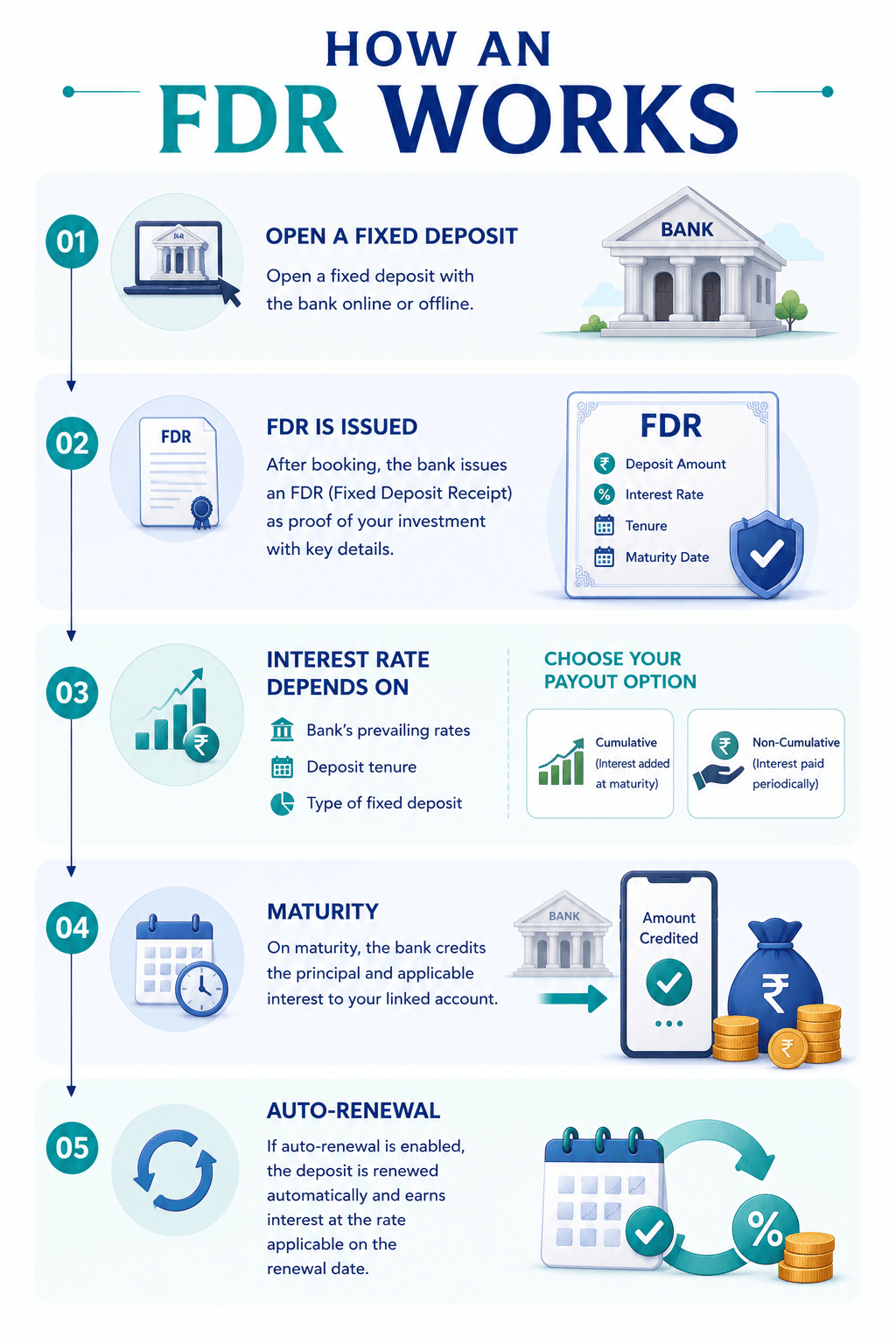
How Does An FDR Work?
An FDR is issued when you open a fixed deposit with a bank, either online or offline. The document records the key details of the deposit, including the deposit amount, interest rate, tenure, maturity date, and other relevant information.
Once the fixed deposit is booked, the bank issues the FDR as proof of the investment. The applicable interest rate depends on factors such as the bank's prevailing rates, deposit tenure, and the type of fixed deposit selected. You may also choose between cumulative and non-cumulative interest payout options based on your financial needs.
Upon maturity, the bank credits the principal and applicable interest to your linked account or automatically renews the deposit if auto-renewal is enabled. The renewed deposit will generally earn interest at the rate applicable on the renewal date.
For example, if you invest INR 5 lakh in a fixed deposit at an annual interest rate of 6% for three years (assuming annual compounding), the maturity amount will be approximately INR 5,95,508.
A table view of the Information mentioned on the FDR
| Information | Purpose |
| Receipt number | Unique reference number assigned to the fixed deposit |
| Depositor name | Helps identify the depositor |
| Deposited amount | The principal amount deposited in the FD |
| Interest rate | Applicable interest rate during tenure |
| Deposit date | Date when the FD begins |
| Maturity date | Date when the FD matures |
| Maturity amount | Amount payable on maturity, including principal and applicable interest |
| Nominee details | Helps facilitate payment to the nominee, where applicable |
| Branch number | To identify the issuing branch |
Conclusion
Fixed deposits (FDs) have always been an attractive investment in India. Investing only in the savings or current account can keep the money idle. However, the FDs have the power to grow money with a stable one-time investment.
It has options for premature liquidity, good interest, safety, investment modes, etc., which will help depositors easily save funds for the short or long term. Moreover, various types of FDs can be opted for based on the suitability of depositors. Depositors should read the scheme document thoroughly before investing.
Investing in Fixed income instruments has become easy! Sign up now to Grip Invest and find suitable opportunities for personal finance.
Frequently Asked Questions On Fixed Deposits
1. Can Alternative Investment provide better returns than FDs?
Alternative investments have a different rationale than traditional options like fixed deposits and stocks. They have market exposure and provide potential returns. However, they also come with higher market risk when compared to FDs. Investing in such options is not very difficult because of technological advancements. Grip Invest is a leading platform in alternative investments.
2. What is Better, FD or RD?
Fixed deposit accounts (FDs) and recurring deposit accounts (RDs) are term deposits, meaning they are confined to a specific term for investment. The main difference between them is regarding the frequency of this investment. In FDs, depositors would invest once with their surplus corpus, and it would grow as per the selection of long-term or short-term plans. On the other hand, RDs are systematic fixed investments made at every equal interval. The better option between these two can be opted as per the depositor’s corpus availability or requirement.
3. What is the Disadvantage of FD?
The fixed tenure of FD may not be suitable for some depositors. Moreover, if the investment is removed early, one loses potential interest. FDs are not exposed to the market and have lower returns than other investment options. It can pose a risk of inefficiency in combating inflation. So, fixed deposits have different disadvantages despite being the most popular investment.
References
1. Reserve Bank of India <https://rbi.org.in/history/Brief_Chro1935to1949.html>
2. The Times Of India <https://timesofindia.indiatimes.com/business/financial-literacy/savings/short-term-fixed-deposits-earn-fd-rates-up-to-8-75-top-banks-for-highest-interest-rates-for-less-than-1-year-tenure/articleshow/109562793.cms>
3. Reserve Bank of India <https://www.rbi.org.in/commonperson/english/Scripts/FAQs.aspx?Id=272>
4. Income Tax Department, Government of India <https://www.incometax.gov.in/iec/foportal/sites/default/files/2023-05/CBDT__e-Filing_ITR-1_Validation%20Rules_Version%201.0.pdf#page=9>
5. Income Tax Department, Government of India <https://incometaxindia.gov.in/Pages/faqs.aspx?k=FAQs+on+Tax+Deducted+at+Source+(TDS)>
Want to stay at the top of your finances?
Join the community of 4 lakh+ investors and learn more about Grip Invest, the latest financial knick-knacks, and shenanigans in the world of investing.
Happy Investing!
Disclaimer - Investments in debt securities/municipal debt securities/securitised debt instruments are subject to risks including delay and/ or default in payment. Read all the offer related documents carefully. The investor is requested to take into consideration all the risk factors before the commencement of trading.
This communication is prepared by Grip Broking Private Limited (bearing SEBI Registration No. INZ000312836 and NSE ID 90319) and/or its affiliate/ group company(ies) (together referred to as “Grip”) and the contents of this disclaimer are applicable to this document and any and all written or oral communication(s) made by Grip or its directors, employees, associates, representatives and agents. This communication does not constitute advice relating to investing or otherwise dealing in securities and is not an offer or solicitation for the purchase or sale of any securities. Grip does not guarantee or assure any return on investments and accepts no liability for consequences of any actions taken based on the information provided. For more details, please visit www.gripinvest.in
Registered Address - 106, II F, New Asiatic Building, H Block, Connaught Place, New Delhi 110001


